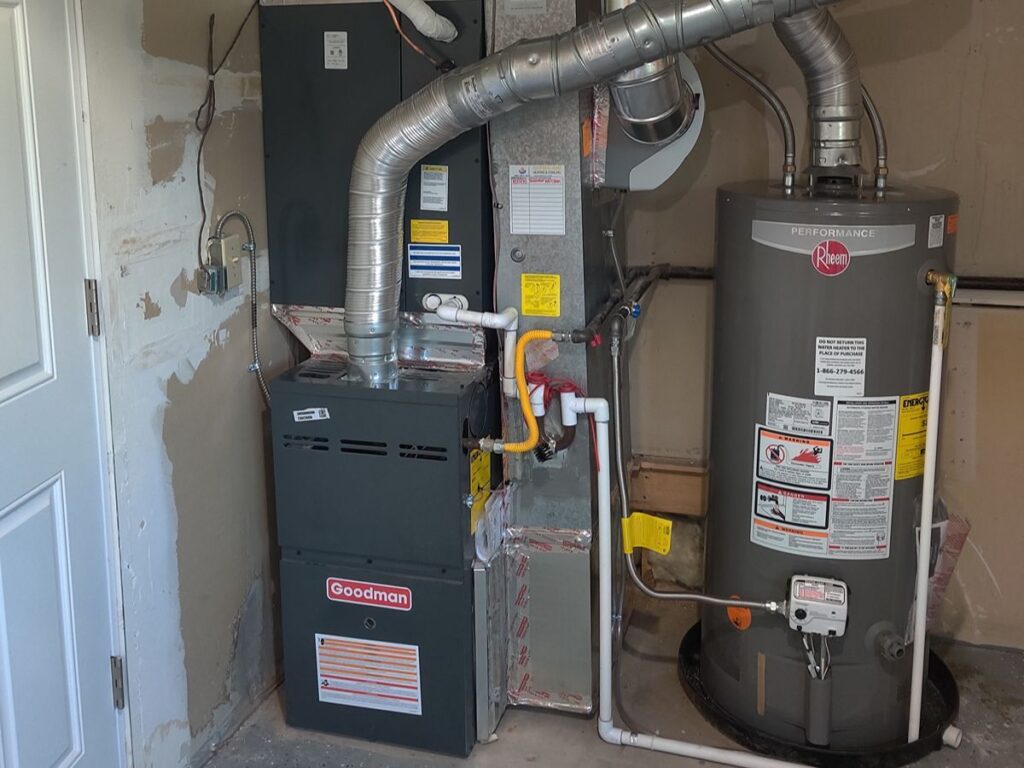
The right furnace size for your Castle Rock home comes from a Manual J load calculation a technician runs on your specific house. At Castle Rock’s elevation of roughly 6,200 feet, a gas furnace is also derated for the thinner air and delivers less heat than its nameplate suggests.
Heating systems in this part of Douglas County are sized for a winter design temperature right around 0 degrees Fahrenheit, which is the outdoor low your heating system is sized to handle. Heating a home at that temperature, at this altitude, leaves no room for a guess based on floor area alone.
Furnace sizing is really about one number: how many BTUs of heat your home loses on the coldest night, and how many your furnace can actually put back after altitude and efficiency take their cut. A unit that is too small can fall behind in a cold snap. A unit that is too large brings its own set of problems. Getting it right means measuring the home, not estimating it, and then accounting for the fact that gas appliances in Castle Rock do not perform the way their factory sea-level rating claims.
Most of Castle Rock’s housing stock is newer, with a large share of homes built since 2000, so insulation, window quality, and air sealing can differ between a home from Founders Village’s early years and one in a recent subdivision. Two homes with identical square footage can need noticeably different furnaces, which is exactly why the calculation beats the chart.
How to calculate the correct furnace size for a home?
A proper furnace size comes from a Manual J load calculation, which is the industry-standard method a technician uses to measure how much heat a home loses. This consultation results in a load calculation (Manual J) to determine the correct furnace capacity, and may add a duct design review if ductwork needs changes. It can be run room by room, rather than relying on a square-footage shortcut.
The calculation looks at wall, ceiling, window, and floor areas and their insulation levels, window performance and orientation, air leakage, and the local climate. In Castle Rock that climate input matters: the load is run against a winter design temperature near 0 degrees Fahrenheit, so the furnace is sized for a genuinely cold night, not an average one.
From there, a technician accounts for altitude. Under the National Fuel Gas Code (NFPA 54), gas appliance input ratings apply up to 2,000 feet; above that, the input must be reduced, either at 4 percent for each 1,000 feet above sea level, as the local authority permits, or according to the manufacturer’s installation instructions. At Castle Rock’s roughly 6,200 feet, the derate is figured from sea level, not from the 2,000 foot mark, so the furnace picked on paper has to be large enough to still deliver the home’s calculated heat load after derating. This is technician work, as it requires full furnace installation and replacement. You should not try to size your own unit from a formula.
What happens if my furnace is too big?
An oversized furnace heats the house in short bursts, then shuts off, then fires again a few minutes later. That pattern is called short cycling, and it is a typical result of a furnace that is too big for the load it is actually carrying. An oversized furnace tends to short cycle, which can reduce comfort and add wear that may shorten the equipment’s life.
You feel it as uneven comfort. The thermostat hits its number fast and cuts the burner, and the house can see wider temperature swings between cycles. The constant starting and stopping also adds wear on the equipment.
It is a common mistake to oversize “to be sure,” especially because altitude already trims a furnace’s real output, which tempts people to jump up a size. The fix is a correct load calculation that lands on the capacity your home actually needs on Castle Rock’s coldest design nights, so the furnace runs in longer, steadier cycles and keeps the whole house even.
What size furnace do I need for a house of 1500 square feet?
A 1,500-square-foot Castle Rock home usually lands somewhere in the range of roughly 45,000 to 75,000 BTU of input, but that is a starting bracket, not an answer. The real number depends on your insulation, windows, and how tight the house is, which is exactly what a Manual J calculation measures.
Square-footage rules of thumb exist because they are quick, not because they are accurate. A well-sealed, well-insulated 1,500-square-foot home can need a good bit less heat than a draftier home of the same size. Orientation matters too, since a home with large west-facing windows gains and loses heat differently than one that is mostly shaded.
Then altitude enters the picture. Because furnaces installed at high elevations like Castle Rock are typically derated, with input commonly reduced about 4 percent for every 1,000 feet above sea level, the furnace you choose on paper has to be sized so its derated, delivered output still covers the home’s load. That is why we treat the square-footage range as a sanity check and let the measured calculation set the final size.
How many square feet can a 40,000 BTU furnace handle?
A 40,000 BTU furnace is a small unit, and in Castle Rock it realistically serves a compact, well-insulated space, often in the neighborhood of 800 to 1,200 square feet depending on the home. But 40,000 BTU is not a single fixed answer, because that number can mean two very different things.
There is the input rating and the delivered output, and they are not the same. A furnace’s input is how much fuel energy it burns; its output is how much usable heat reaches your rooms, which depends on its AFUE efficiency. A 40,000 BTU input furnace at 96 percent AFUE delivers only about 38,400 BTU of actual heat before anything else is considered.
At Castle Rock’s elevation, you lose more on top of that. Once the input is derated for altitude, a nameplate 40,000 BTU furnace is putting out noticeably less heat than that figure implies, which shrinks the space it can comfortably keep warm on a cold night. That gap between the sticker number and real delivered heat is the whole reason sizing here has to be done by measurement, not by a chart. If you want us to look at your specific home and confirm the right capacity, you can have your current system assessed as part of the conversation.
Picking the right furnace means matching real delivered heat to your home’s actual load on the coldest design nights at roughly 6,200 feet, and that is not something a square-footage chart can get right. At Alpha Air Heating & Cooling, we handle furnace replacement in Castle Rock by determining the load calculation, sizing for the altitude derate, and setting the furnace up for local conditions so it runs steady and keeps the whole house even. We are NATE certified and locally based, and we offer free estimates. Call us at (720) 284-9566 and we will size it right for your home.