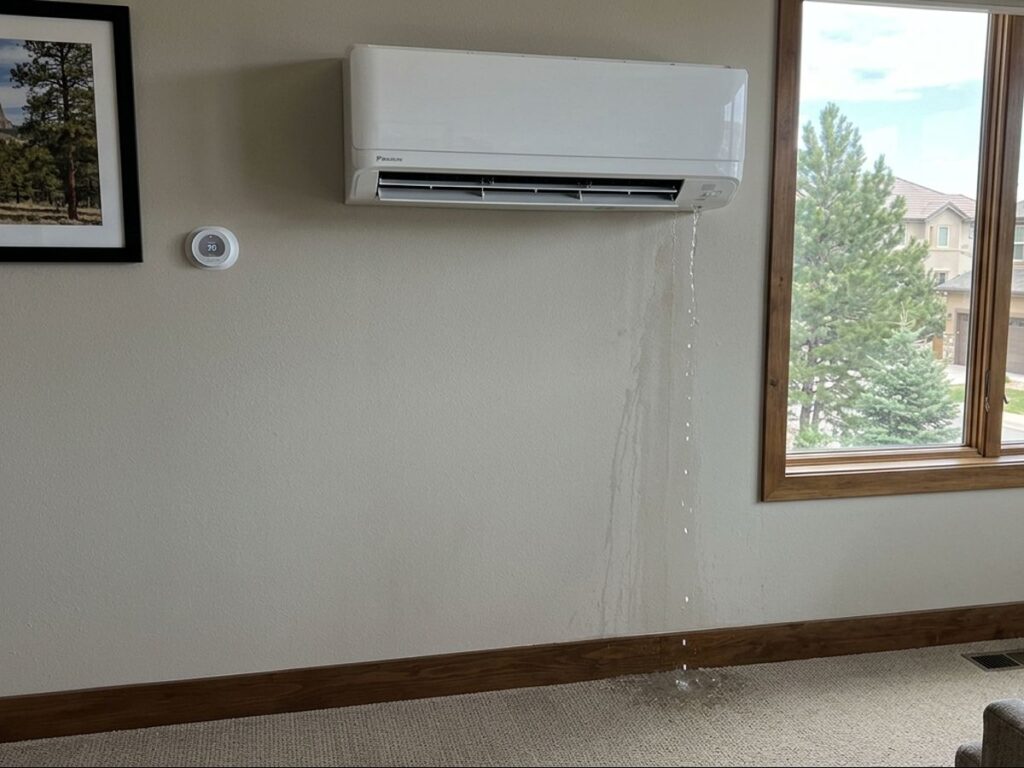
If your ductless mini split is dripping water inside your Castle Rock home, the first thing to check is the drainage. The indoor head makes water as a normal part of cooling, and when that water cannot drain out, it backs up and spills onto your wall or floor.
That matters more here than in a wetter place. Castle Rock shares Colorado’s semi-arid climate, with average July relative humidity in the 40s, according to published weather averages. Because your mini split is not pulling huge volumes of moisture out of humid air, a head that suddenly leaks is usually telling you the drain path is blocked or the unit is not pitched right, rather than that it is simply overwhelmed by condensation.
When your mini split runs in cooling or dry mode, it pulls moisture out of the air, and that water collects in a drain pan inside the indoor unit. From there it drains out through a hose that has to slope downward along its run, with no dips that hold water. When dirt or dust clogs that drain path, or the hose dips and holds water, the water cannot drain properly and can leak out of the indoor unit instead.
Water from the indoor head is a cooling-season event. A mini split should not drip water from the indoor head while it is running in heat mode. In winter, meltwater forming at the outdoor unit during the defrost cycle is normal and is a different thing entirely. If you see water indoors, you are dealing with the condensate side of the system.
How much does it cost to fix a leak in a mini split?
The cost of clearing and flushing a mini split drain line depends on how bad the clog is, how the line is routed, and local labor rates, but professional drain-line clearing typically starts around $100.
If the leak is not a simple clog, the drain pan and the way the line is routed need a closer look. If a technician finds a refrigerant problem instead, that is a separate repair, and by law refrigerant work has to be done by an EPA-certified technician.
Can I still run my mini split if it’s leaking water?
No. Stop using it and leave it off until the leak is found and fixed. Running a leaking head keeps pushing water where it should not go, and that water can damage walls, flooring, and furniture.
There is a local reason to act fast, too. A lot of Castle Rock homes have finished or walkout basements, and mini split heads are a popular way to condition those lower levels. Water running down behind that finished wall can soak into materials and feed mold before you ever see a stain. Shutting the system down protects the room while you line up a repair.
How to unclog a mini split drain line?
There are a few simple checks a homeowner can make before calling in a pro. Keep your own steps to the simple, safe stuff: power, filter, and the reachable part of the drain line. Do not open the head’s electrical compartment, and do not touch anything on the refrigerant side.
- Turn the unit off at the breaker or disconnect so it cannot cycle on while you work.
- Pop open the front of the indoor head, lift out the air filters, and rinse them. A dirty filter restricts airflow.
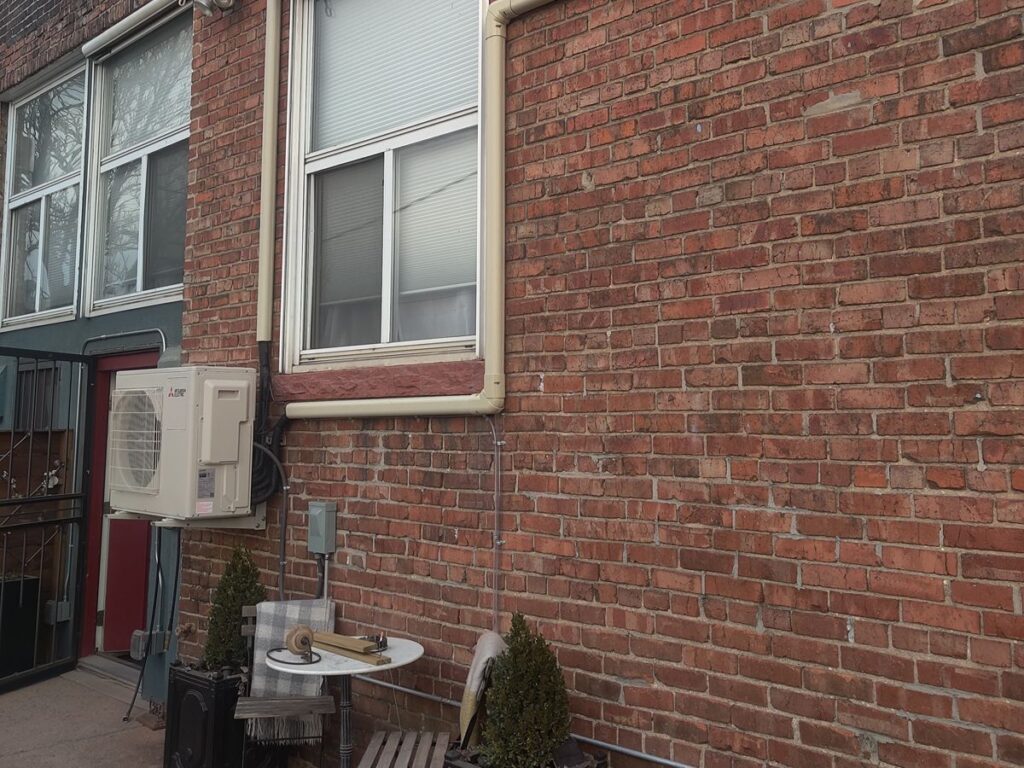
- Check the outdoor end of the drain line and clear any visible debris. The line should run downhill with no dips that hold water, and its end should not sit in water.
- Attach a wet/dry shop vac to the outdoor end of the line and run it for a minute or two to pull the clog loose.
If you want to flush the line afterward, check your manufacturer’s instructions first and use only a cleaner they recommend, since the wrong cleaner can damage plastic parts inside the unit and cause leaks. If the water flows freely after you clear it, you caught it early. If it clogs again within days, have a pro check the drain line’s slope and routing.
How often should AC drain lines be cleaned?
A good general rhythm is to have the condensate drain inspected once a year as part of a pre-season check-up, and to clean the indoor head’s filters far more often, following your owner’s manual; some manufacturers recommend every two weeks. The line stays dark and damp inside, which is exactly where algae and slime like to grow into a plug, so it’s worth having it checked regularly.
Our semi-arid air changes the math a little. Because Castle Rock humidity is low, your mini split produces less condensate than the same unit would in a muggy climate, so lines here tend to clog slower. That is good news, but it also means people forget the line exists until it backs up, often on the first hot stretch when the system finally runs for hours at a time. Folding a drain-line flush into ductless maintenance in Castle Rock is the simplest way to stay ahead of it, and it is a good time to confirm the head is still pitched correctly.
A mini split leaking onto a finished basement wall in Castle Rock is the kind of small problem that gets expensive fast if it sits. Our team handles ductless mini split repair, drain cleaning, and maintenance for Castle Rock and Douglas County, and we can tell you quickly whether you are looking at a quick drain clear or something more. To get the leak diagnosed and stopped, call Alpha Air Heating & Cooling at (720) 284-9566.